

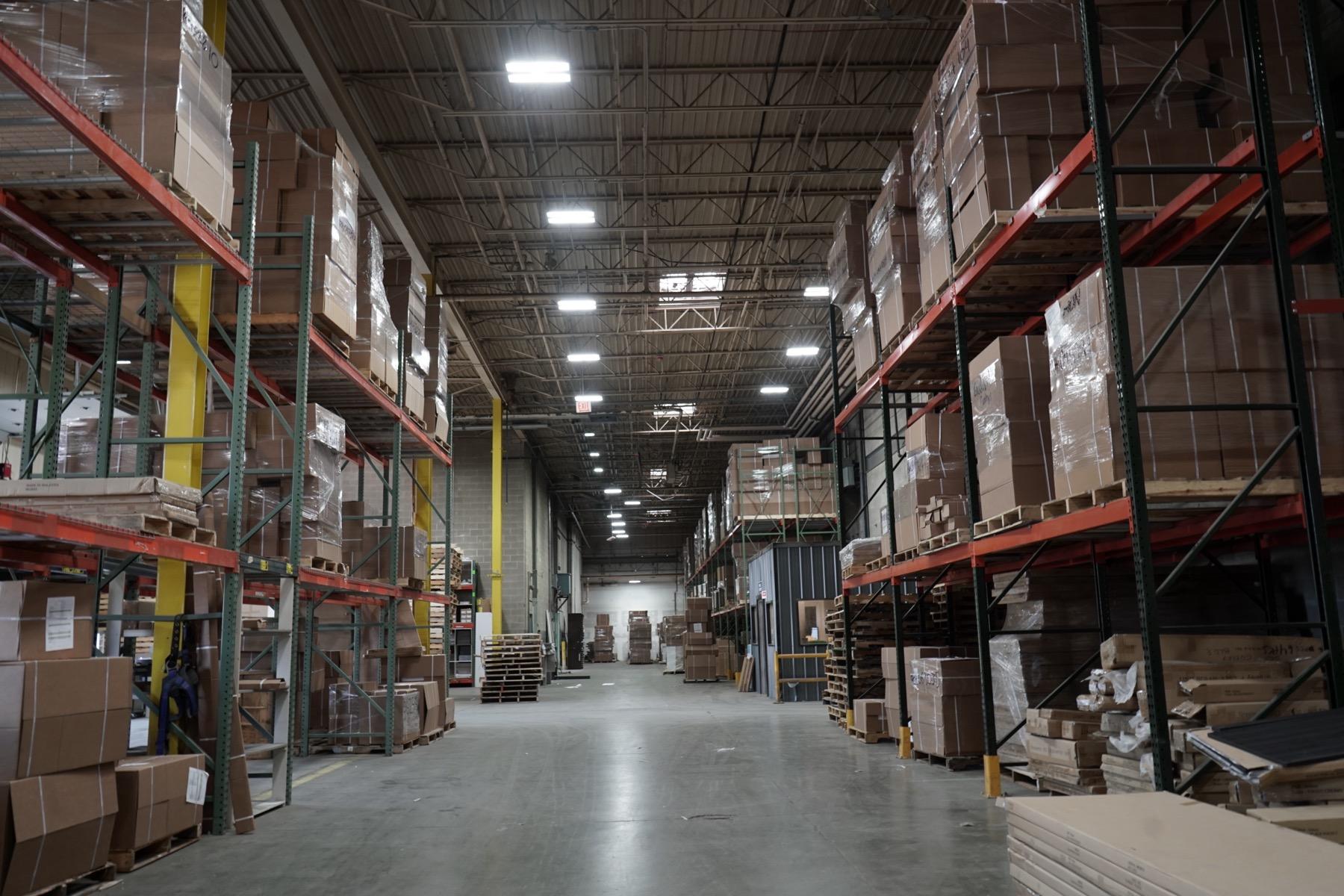
WAREHOUSES
Warehouse Photometric Plans.
Loading courts, truck circulation, and exterior yard documentation for industrial lighting submittals with OSHA and jurisdiction compliance.
THE REQUIREMENT
What the code requires and why.
3 fc
Active storage areas (OSHA)
5 fc
Indoor warehouses and exitways (OSHA)
15:1
Max uniformity ratio (SeaTac)
Warehouse and industrial sites typically combine truck courts, loading docks, exterior storage, employee routes, and building exits in one lighting submittal. Reviewers want documentation that the yard will support safe movement and wayfinding without throwing uncontrolled light beyond the site.
OSHA's construction illumination table sets a minimum of 3 fc for active storage areas, loading platforms, refueling, and field maintenance, and 5 fc for indoor warehouses, corridors, hallways, and exitways. Those published values are often the operational baseline owners and reviewers expect the exterior yard design to support.
For exterior circulation and parking within industrial districts, municipal lighting tables still apply. SeaTac's District 1 standards require at least 0.5 fc, no more than 7.5 fc, and a maximum-to-minimum uniformity ratio of 15:1. A warehouse photometric plan ties those yard conditions back to the loading layout and property boundaries before the permit set is submitted.
WHAT YOU RECEIVE
Your warehouses photometric package.
01
Site plan overlay for loading courts, drive aisles, employee parking, and exterior circulation
02
Point-by-point calculation grid across docks, truck maneuvering areas, and site entries
03
Fixture schedule with pole, wall-pack, and canopy data where applicable
04
Property-line light trespass review for industrial edges and adjacent parcels
05
Compliance summary tying the lighting layout to published safety and jurisdiction criteria
06
Two revision rounds for reviewer comments or fixture changes during coordination
All plans modeled in AGi32 using IES LM-63-19 photometric data files.
COMPLETE DOCUMENTATION
Your warehouses permit may also require:
Warehouse and industrial permits typically involve high-bay interior fixtures with significant connected wattage alongside exterior yard lighting. The combined load makes electrical calculations and energy code documentation critical to the permit package.
Load Calculations
NEC Article 220 electrical load analysis for high-bay interior fixtures and exterior yard lighting. High-bay installations often represent the largest connected lighting load on the panel.
COMcheck Compliance
Energy code compliance certificate per ASHRAE 90.1 documenting that interior warehouse and exterior yard connected loads meet the building's lighting power density allowance.
Voltage Drop Verification
Conductor sizing calculations for long-run circuits serving exterior yard poles and loading dock fixtures at distance from the electrical room.
Permit Coordination
Assistance coordinating the interior and exterior lighting documentation into a single permit package and communicating with the plan reviewer.
Controls: high-bay occupancy sensing with dimming, daylight harvesting for skylighted areas, exterior yard scheduling.
Need the complete package? We scope everything together — one fee, one timeline, one point of contact.
APPLICABLE STANDARDS
Code references for warehouses lighting.
- OSHA 29 CFR 1926.56
- Table D-3 lists 3 fc for active storage areas, loading platforms, refueling, and field maintenance, and 5 fc for indoor warehouses, corridors, hallways, and exitways.
- ANSI/IES RP-8-25
- Current IES recommended practice used to frame exterior circulation, parking, and obtrusive-light control around industrial sites.
- SeaTac SMC 17.24.020
- District 1 industrial-area parking: 0.5 fc minimum, 7.5 fc maximum, and 15:1 maximum-to-minimum uniformity.
COMMON QUESTIONS
Common questions about warehouses.
OSHA 29 CFR 1926.56 sets operational minimums of 3 fc for active storage areas and loading platforms and 5 fc for indoor warehouses, corridors, and exitways. Exterior circulation and parking then follow the municipal table—SeaTac District 1 industrial parking runs 0.5–7.5 fc at a 15:1 uniformity ratio. The plan ties the yard design back to those published figures.
We produce the permit-ready photometric plan—the calculated grids, fixture schedule, and trespass checks for the truck court, docks, and yard. Warehouse lighting design more broadly includes interior high-bay layout and controls; we document the connected load and energy compliance for those when they're part of the submittal, but the photometric plan is what clears site-plan review.
Often, yes—on the electrical and energy-code side. High-bay installations are usually the largest connected lighting load on the panel, so NEC Article 220 load calcs and COMcheck (ASHRAE 90.1) documentation typically accompany the exterior photometric plan. We can scope the interior and exterior together as one package.
Exterior yard and circulation plans typically run $400–$900 at 48-hour standard turnaround, rush available. Send the site and dock layout and we confirm scope and a fixed fee, usually the same day.
RELATED READING
Keep reading
- Warehouse lighting design guideZone-by-zone foot-candle targets for industrial sites.
- What is a photometric plan?The full deliverable, with an annotated sample plan.
- How much does a photometric plan cost?The honest $300–$2,500 range and what moves it.
- Foot-candle requirements by property typeTypical IES-based maintained fc ranges for every property type.
Scoped to your warehouses project.
Every warehouse and industrial yard plan is scoped to the loading court layout, circulation areas, and applicable OSHA and jurisdiction standards. Send the site plan and we'll confirm the scope and fee, typically same day. No obligation.
Learn about our pricing model →Need an Industrial Lighting Submittal?
Send the warehouse site plan, dock layout, or current background set. We'll prepare a permit-ready photometric package for the yard and circulation areas.