

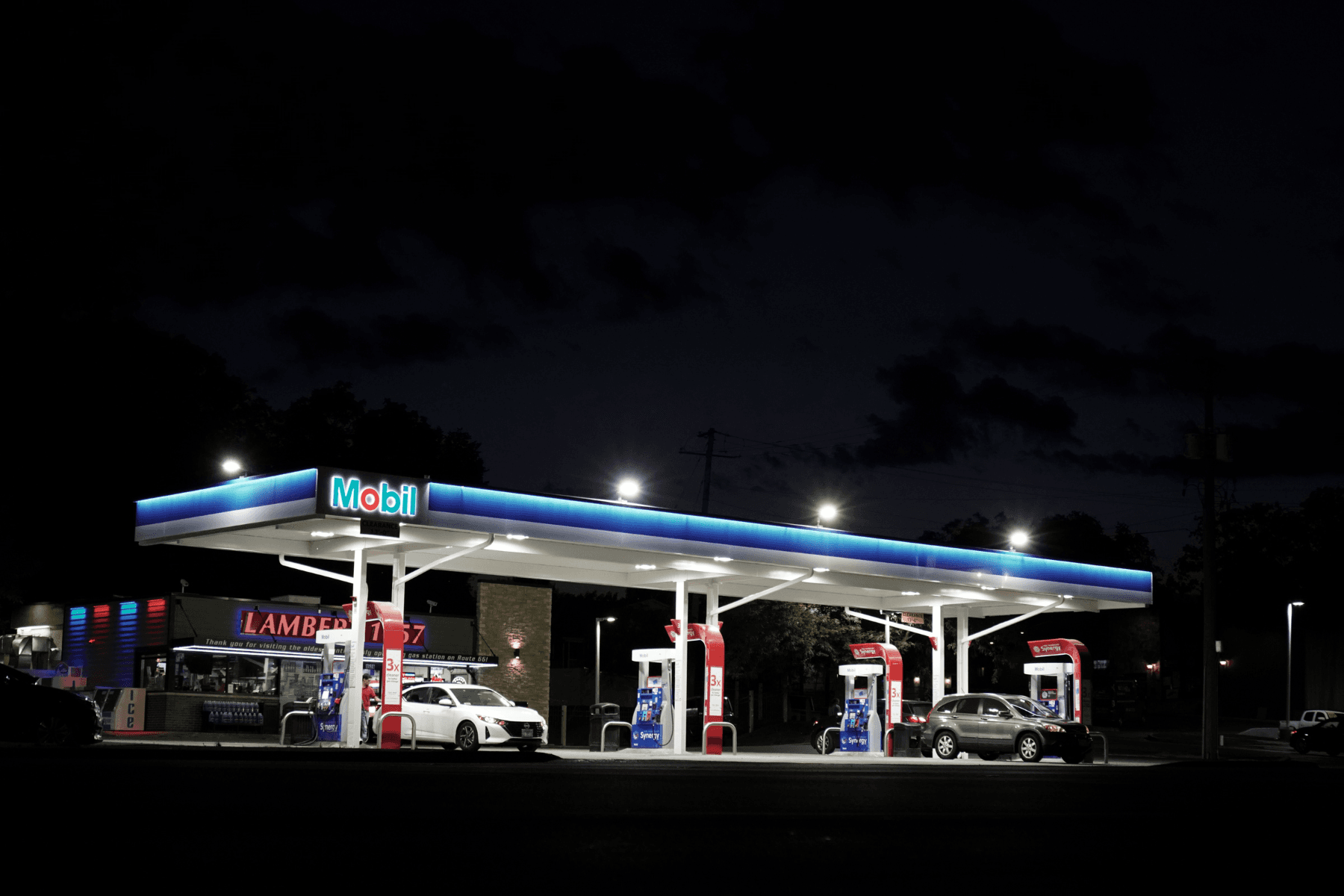
GAS STATIONS
Gas Station Photometric Plans.
Canopy lighting, pump islands, and perimeter spill control documented in a single permit-ready package for fueling-site code review.
THE REQUIREMENT
What the code requires and why.
>= 1.0 fc
Minimum at grade (SeaTac)
<= 5.5 fc
Maximum at grade (SeaTac)
4:1
Max uniformity ratio
<= 85°
Canopy shielding from vertical
Gas stations are reviewed differently than ordinary site lighting because the project combines canopy lighting, pump islands, drive aisles, and perimeter spill control in one submittal. The plan has to show strong visibility where fueling happens without over-lighting the edge of the property.
SeaTac publishes separate service-station criteria that require a maintained horizontal illuminance of at least 1.0 fc and no more than 5.5 fc at finished grade, with a maximum-to-minimum uniformity ratio of 4:1. The same code section also requires canopy fixtures to be recessed, flush with the canopy, or shielded to no more than 85° from vertical.
Other jurisdictions go further and cap the total brightness of the fueling area. Pleasant Hill, for example, limits service-station lighting to 30 fc at finished grade unless additional intensity is approved, which is why the photometric package has to document both the pump zone and the site perimeter together.
WHAT YOU RECEIVE
Your gas stations photometric package.
01
Canopy lighting layout with fixture placement, mounting conditions, and orientation
02
Point-by-point grade calculations at pump islands, drive aisles, and parking areas
03
Perimeter light trespass checks at property lines and public frontages
04
Fixture schedule covering canopy luminaires and site poles in one permit package
05
Shielding, cutoff, and BUG documentation where the jurisdiction requests it
06
Jurisdiction-specific compliance summary for canopy and site-lighting requirements
07
Two revision rounds for permit comments or fixture substitutions
All plans modeled in AGi32 using IES LM-63-19 photometric data files.
COMPLETE DOCUMENTATION
Your gas stations permit may also require:
Gas station permits combine canopy lighting, pump island fixtures, and site pole lighting in a single submittal. The multiple lighting zones create separate load calculations and energy code documentation requirements that must be submitted together.
Load Calculations
NEC Article 220 electrical load analysis covering canopy luminaires, pump island fixtures, and site area lighting as separate circuits. Demand factors calculated for the combined connected load.
COMcheck Compliance
Energy code compliance certificate documenting canopy and site lighting separately against the building's watts-per-square-foot allowance per IECC or ASHRAE 90.1.
Voltage Drop Verification
Conductor sizing calculations for branch circuits serving canopy fixtures and remote site poles. Canopy circuits are typically short; site perimeter runs may require upsized conductors.
Permit Coordination
Assistance assembling the combined canopy and site lighting submittal package and communicating with the plan reviewer to resolve comments.
Controls: canopy scheduling and daylight harvesting, emergency egress lighting integration, site perimeter astronomical timeclocks.
Need the complete package? We scope everything together — one fee, one timeline, one point of contact.
APPLICABLE STANDARDS
Code references for gas stations lighting.
- ANSI/IES RP-8-25
- Current IES recommended practice for roadway and parking facility lighting; relevant to circulation areas, site entries, and obtrusive-light control around fueling sites.
- SeaTac SMC 17.36.020
- Service stations and canopies: 1.0 fc minimum, 5.5 fc maximum, 4:1 maximum-to-minimum uniformity, with canopy shielding limited to 85° from vertical.
- Pleasant Hill MC 18.55.140
- Service-station lighting is limited to 30 fc at finished grade unless a higher level is specifically approved.
COMMON QUESTIONS
Common questions about gas stations.
Under the fueling canopy, common industry design targets run 20–50 fc on the task plane so fueling and payment areas read clearly after dark. Municipal codes then cap brightness at finished grade—SeaTac limits service-station grade illuminance to 1.0–5.5 fc and Pleasant Hill caps it near 30 fc. The plan documents the canopy and the site perimeter together so neither the visibility target nor the municipal cap is missed.
The photometric plan is the calculated, permit-ready document—canopy, pump islands, drive aisles, and perimeter spill in one package. Gas station lighting design, more broadly, also covers fixture selection and aesthetics. For code review, the photometric plan is what the jurisdiction reads, and we build it manufacturer-agnostic so the layout serves the site rather than a fixture catalog.
Because a fueling site concentrates bright canopy lighting close to property lines and public roadways. Reviewers want strong, uniform light where fueling happens—often a 4:1 max-to-min ratio—without uplight or spill that violates dark-sky or trespass rules. Canopy fixtures usually must be recessed, flush, or shielded; SeaTac requires shielding to no more than 85° from vertical.
Most canopy-plus-site fueling plans run $400–$800 at standard 48-hour turnaround, with 24-hour and same-day rush available. Send the canopy layout or site plan and we confirm scope and a fixed fee, usually the same day.
RELATED READING
Keep reading
- Dark-sky ordinances explainedBUG ratings, cutoff, and the rules that govern canopy uplight.
- Light trespass explainedHow property-line spill is measured and capped.
- What is a photometric plan?The full deliverable, with an annotated sample plan.
- Foot-candle requirements by property typeTypical IES-based maintained fc ranges for every property type.
Scoped to your gas stations project.
Every gas station and canopy plan is scoped to the fueling area layout, site perimeter, and jurisdiction requirements. Send the canopy layout or site plan and we'll confirm the scope and fee, typically same day. No obligation.
Learn about our pricing model →Need a Fueling-Site Lighting Plan?
Send the canopy layout, site plan, or existing background set. We'll prepare a permit-ready photometric package for the full fueling area.